Rrotary tiller
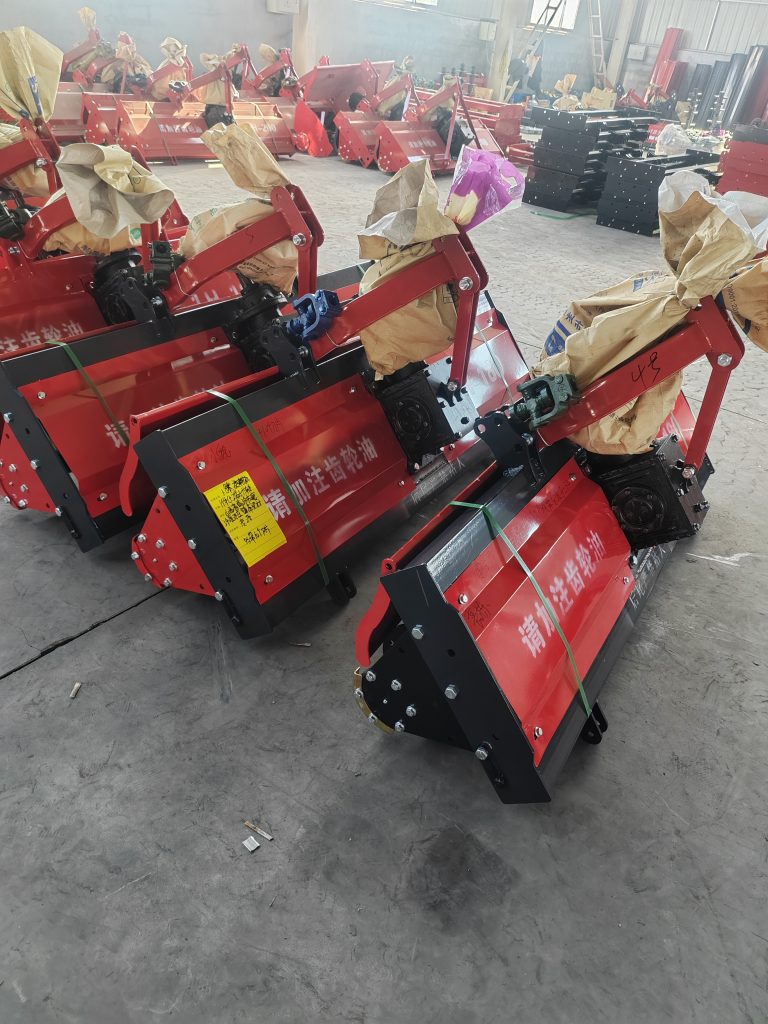
A rotary tiller is one of the highest-value implements you can put behind a tractor: it turns a field, an orchard row or a greenhouse bed into a seedbed in a single pass. This guide covers how a rotavator works, the types available, how to match one to your tractor, and what to check before you buy.
SEO Title: Rotary Tiller for Tractor_25-120 HP Three-Point Hitch Rotary Tiller_Rotavator Supplier
SEO Description: Ginreet rotary tillers are PTO-driven, three-point hitch mounted rotavators matched to 25-120 HP tractors. Working widths from 1.0 m to 3.0 m, working depth 8-16 cm, side-drive and central-drive options, suitable for orchards, greenhouses, field seedbed preparation and paddy.
- What Is a Rotary Tiller?
A rotary tiller — also called a rotavator or rotary cultivator — is a PTO-driven soil preparation implement that mounts on a tractor’s three-point hitch. A horizontal rotor carries a set of curved blades, and power from the tractor’s PTO runs through the implement gearbox and a chain or gear drive to spin that rotor.
As the tractor moves forward, the blades cut, lift and throw the soil, breaking clods and mixing crop residue in one pass. That is the practical advantage: a plough-and-harrow sequence needs two or three passes, while a rotary tiller leaves a seedbed in a single pass.
Most tractors supply PTO power at 540 or 720 r/min. Gearbox ratios step that speed down to a rotor speed that gives good clod breakdown without over-pulverising the soil, which would damage structure and cause surface crusting.
One sentence: a rotary tiller converts one pass across the field into a finished seedbed. - Types of Rotary Tillers
Rotary tillers differ mainly in three ways: how the rotor is driven, how heavily the machine is built, and how wide the working width is. The table below summarises the common configurations.
Type Drive layout Best for Matched tractor
Light-duty Side drive (chain / side gear) Greenhouse, small orchard, small plots 12-40 HP
Medium-duty Side drive or central drive Field seedbed preparation 40-80 HP
Heavy-duty Central drive Paddy, heavy stubble, clay soil 80-120 HP
Orchard Side drive, narrow width Working between orchard rows 25-60 HP
Side drive versus central drive. A side-drive tiller places the gearbox at one end of the rotor and transmits power through a chain or side-gear case. It is simpler, lighter and cheaper. A central-drive tiller puts the gearbox in the middle of the rotor and drives both halves equally, which gives more even loading and better durability at large widths.
As a rule, widths above roughly 2.3 m and heavy paddy work favour central drive. Below that, a well-built side-drive tiller is usually the more economical choice.
Duty class matters more than colour. A light-duty frame will do greenhouse work for years, but the same tiller put behind a 100 HP tractor in stubble will fail early. Match the duty class to the largest tractor the tiller will ever be used with, not to today’s machine. - Key Specifications to Check Before You Buy
Working width is the number most buyers look at first, but several other numbers decide whether the implement actually suits your tractor.
• Working width — 1.0 m to 3.0 m in common sizes; narrower for orchard and greenhouse, wider for open field;
• Working depth — typically 8-16 cm for standard tillers; deeper work needs a heavier frame and more power;
• PTO input speed — 540 r/min is the most common; 720 r/min suits tractors that offer the higher speed and generally gives a finer tilth;
• Gearbox power rating — the gearbox, not the frame, is usually the first thing to fail; confirm the rated power with margin above your tractor’s PTO output;
• Number and type of blades — more blades per flange give a finer finish and a smoother ride; blade steel grade decides wear life in stony or sandy soil;
• Drive type and rotor speed — side drive for economy, central drive for width and durability;
• Hitch category and weight — Category I for compact tractors, Category II for larger machines; check that the three-point lift capacity handles the implement weight.
Practical tip: when comparing two tillers of the same width, weigh them. A tiller that is noticeably lighter than its rivals is usually lighter in the frame and the blade steel too. - Matching a Rotary Tiller to Your Tractor
The matching table below covers working widths from 1.0 m to 3.0 m and tractor power from 12 HP to 120 HP. Model numbers follow the common 1GQN series designation.
Working width Example model Matched tractor power Typical use
1.0 m 1GQN-100 12-25 HP Greenhouse, narrow orchard rows
1.25 m 1GQN-125 15-30 HP Small orchard, greenhouse
1.5 m 1GQN-150 20-40 HP Orchard, small field
1.8 m 1GQN-180 35-55 HP Field seedbed preparation
2.0 m 1GQN-200 45-65 HP Field seedbed preparation
2.3 m 1GQN-230 55-80 HP Field, stubble incorporation
2.5 m 1GQN-250 70-90 HP Large field
2.8 m 1GQN-280 80-100 HP Large field
3.0 m 1GQN-300 90-120 HP Paddy, large-scale field
Rule of thumb: allow roughly 25-30 HP of tractor power for every 1 m of working width when tilling to about 12-15 cm in normal soil. Heavy clay, deeper working depth or high forward speed all demand more.
Two more checks before ordering. First, confirm the PTO speed your tractor delivers — a 540 r/min-only tractor and a tiller geared for 720 r/min will not work well together. Second, confirm the hitch category and lift capacity, because a Category II tiller on a Category I tractor will not mount correctly. - Applications: Orchard, Greenhouse, Field and Paddy
The right working width depends on where the tiller has to go, not only on tractor power.
• Orchard — between orchard rows the constraint is width, not power. A 1.0-1.5 m tiller behind a compact 25-60 HP orchard tractor keeps the machine inside the row spacing and away from tree roots. Rotary tillage in orchards is normally shallow, enough to control weeds and incorporate fertiliser or green manure without cutting through feeding roots;
• Greenhouse — greenhouse work needs a narrow, light implement that fits through the door and turns in a short headland; light-duty 1.0-1.25 m tillers on small tractors are the usual answer;
• Field — open-field seedbed preparation is where the 1.5-3.0 m range works, with depth set to around 12-15 cm; where straw or stubble must be incorporated, a heavier frame and slower forward speed give a more complete mix;
• Paddy — paddy tillage combines wet, heavy soil with high resistance, so it needs a central-drive, heavy-duty tiller and a tractor at the top of the matched power range. - Blades: The Part That Decides Your Tilth
The blades do the actual work, and their condition matters more than most operators expect.
Common blade types. L-type blades are the general-purpose choice and suit most field and orchard work. C-type blades give a more aggressive cut and better residue handling in heavy stubble. Curved blades are common on orchard and greenhouse tillers where a finer finish is wanted.
Number per flange. Four blades per flange is the standard general-purpose arrangement. Six blades per flange give a finer finish and a smoother-running implement, at the cost of more power draw.
Wear and replacement. Blade tips wear fastest in sandy and stony soil. Check them before each season, and replace blades as a matched set rather than one at a time — an unbalanced rotor shakes the whole machine and shortens gearbox life. Always re-torque blade bolts after the first few hours of work on a new tiller. - Maintenance and Safe Operation
A rotary tiller is simple to keep running, provided a short routine is actually followed. - Grease points — grease the rotor bearings, the side-drive case and the depth-control pivots at the intervals in the manual, and more often in dusty conditions;
- Gearbox oil — check the level before the season and change it as specified; low oil is the usual cause of early gearbox failure;
- Drive chain or side gear — check tension and lubrication, and adjust as the manual directs;
- Blades and bolts — inspect for cracks and wear, replace as a set, and re-torque bolts regularly;
- Depth control — keep skids, rollers or the tailboard adjusted so the tiller works at the intended depth without the frame riding on the ground;
- Storage — clean soil off the machine, grease exposed metal, and store under cover.
Safety, without exception: stop the engine, remove the key and disengage the PTO before clearing a blockage or touching the blades. Never clear a blockage while the rotor is turning, and never let anyone stand behind or beside the tiller while the PTO is engaged.
Keep every PTO and drive guard in place — a missing guard is the most common cause of serious injury with this type of implement.
