404gardentractors
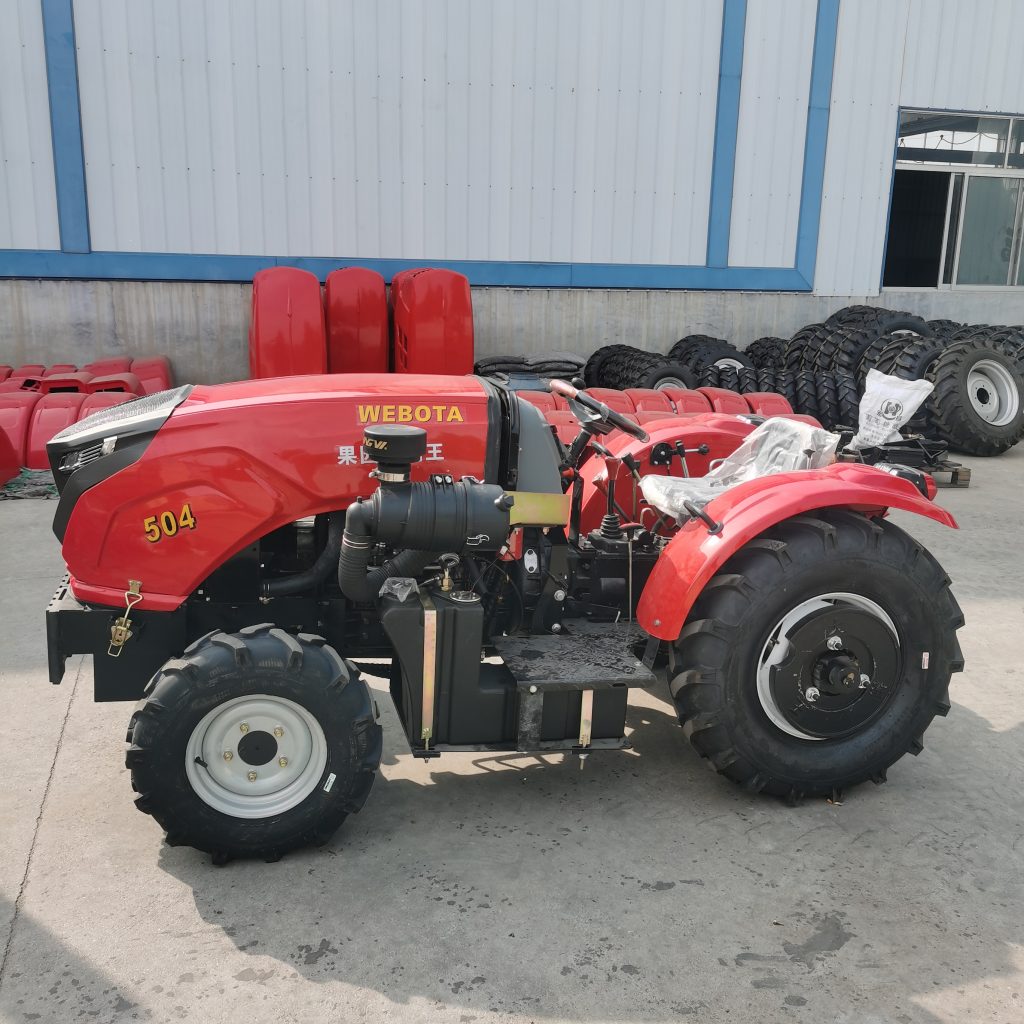
For greenhouse growers, the pain points of choosing a tractor are very concrete: the doorway is barely a metre wide, the roof structure hangs low, and the headland is smaller than half a parking space. No matter how much horsepower a machine has, if it cannot get inside and cannot turn around, it is useless.
The 404 Greenhouse King (model DY404-2, 4WD wheeled tractor) is designed around exactly these constraints — overall dimensions of 3000×1310×1950 mm (to the safety frame), a body only 1.31 m wide and just under 2 m tall, a wheelbase of 1550 mm, and a minimum service mass of 1360 kg.
What does a 1.31 m body width mean in practice? The clear width of a typical single-span vegetable greenhouse doorway is between 1.2 and 1.5 m, so a 1310 mm machine fits through with room to spare on both sides. The overall height of 1950 mm (to the safety frame) also clears the beams of most greenhouse structures, so there is no need to worry about scraping the frame on the way in.
The minimum ground clearance is 255 mm, measured at the bottom of the transfer box, which keeps the machine from bottoming out over beds and drip-irrigation lines inside the house. The short 1550 mm wheelbase combined with the 1360 kg service mass delivers a very tight turning radius — even a two- or three-metre headland is enough to turn around in one move.
The wheel tread is where this machine shows how well it understands greenhouses: front 930–1150 mm, rear 950–1150 mm, commonly set at 930/950 mm, steplessly adjustable. Bed spacing differs greatly between crops and growing systems — tomato and cucumber beds usually run 1.0–1.2 m apart, and elevated strawberry systems leave even narrower access paths.
With the tread narrowed to 930 mm, the tyres run exactly on the access path, without pressing on beds, damaging roots or catching drip lines. When it is time to leave the greenhouse for some open-field work, widening the tread to 1150 mm immediately improves lateral stability.
For power, the 404 Greenhouse King uses a Yangdong YD4R40V1 engine: in-line, water-cooled, four-stroke, naturally aspirated, 4 cylinders, with a rated power of 29.4 kW (40 HP) at 2400 r/min.
On a 1.36-tonne machine, this power-to-weight ratio is well matched — greenhouse work does not ask for brute force, but for control and smoothness at low speed. The naturally aspirated layout is simple, with fewer failure points, which suits the hot, humid, dust- and fibre-laden environment inside a greenhouse and keeps routine maintenance easy.
The gearbox offers 8 forward + 2 reverse gears (4+1 main shifts, 2 sub shifts), with a maximum theoretical design speed of 30.52 km/h. The fine gear steps exist for a reason: rotary tillage and furrowing inside a greenhouse need low speeds for a stable, even finish, while 30.52 km/h is ample for transfers and short hauls on farm roads. Eight forward gears are about having the right gear for fine work, not about speed for its own sake.
The working equipment is built around a Category I three-point hitch with 1 group of hydraulic output and a power take-off shaft with 6 splines at standard speeds of 540/760 r/min. One hydraulic circuit is enough for greenhouse work — lifting the rotary tiller or adjusting furrow depth is one action, one circuit.
The 540 r/min setting matches conventional implements such as rotary tillers and furrow openers, while 760 r/min drives implements that need higher speeds, widening the range of tools one machine can carry. The tyres are a narrow pattern, 7.00-12 front and 13.6-16 rear, with low ground pressure so the soil inside the greenhouse is less likely to be compacted.
Standard ballast is 26 kg at the front and 28 kg at the rear. On a light machine with a narrow tread, ballast matters even more: it keeps the front wheels planted when carrying mounted implements, and keeps the machine steady on slopes and during headland turns — balance work that a compact chassis simply has to get right.
Put these figures into real settings, and the 404 Greenhouse King serves several kinds of buyers. First, growers running single-span or multi-span vegetable greenhouses, doing in-house rotary tillage, furrowing, spraying and hauling seedlings and produce. Second, horticultural parks growing strawberries, tomatoes and cucumbers, where rows are narrow and the work is frequent.
Third, narrow-row dense orchards and small hillside plots that need a 4WD machine which gets in and turns around. And fourth, nurseries and demonstration farms that want one agile, general-purpose chassis for a range of small implements.
Two details are worth noting in daily use: work inside the greenhouse in a low gear and keep the engine speed in its economical range, which protects work quality and limits exhaust build-up indoors; and select 540 or 760 r/min at the PTO according to the implement’s requirement, avoiding prolonged overspeed running. Measure the doorway, the frame height and the width of the access paths before the season starts — it is far cheaper than retrofitting afterwards.
40 HP is not a big number — but the 1310 mm width, 1950 mm height, 930 mm narrow tread and 1550 mm short wheelbase are where this machine’s real value lies. For a greenhouse tractor, getting the dimensions right matters more than chasing horsepower — and the 404 Greenhouse King gets the dimensions right.